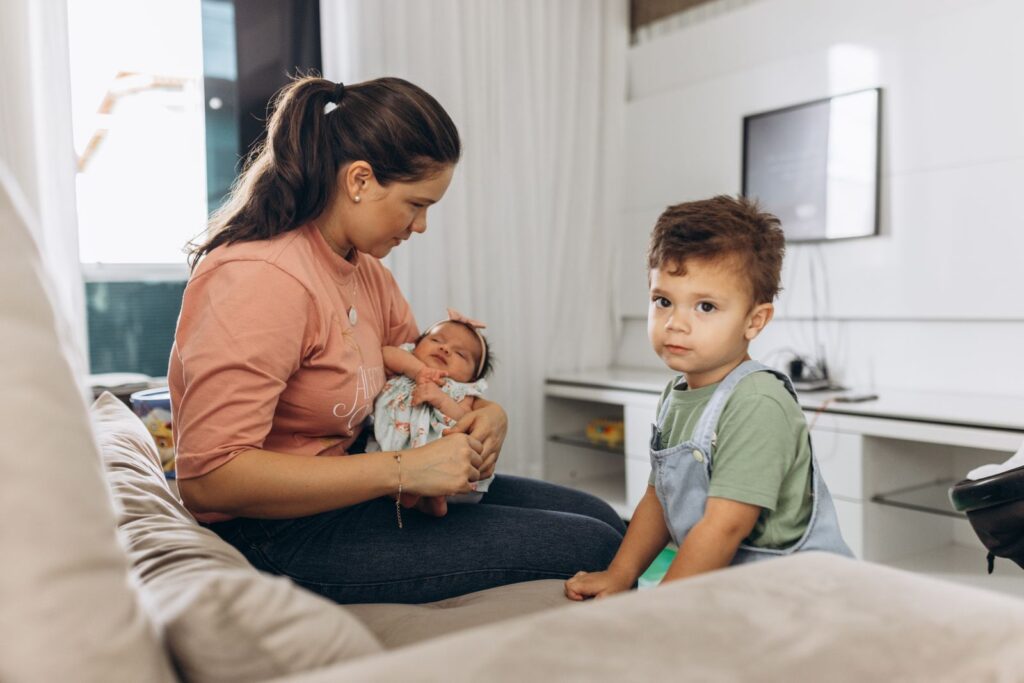
It is 4:30 in the afternoon. The baby is on your chest, finally asleep, and your older one is at your knee asking you to open the yogurt, read the book, watch this, look at me, look at me. You are looking. You are also holding your voice very steady, because somewhere in the last ten minutes you started to feel like you might come apart.
Everyone told you the first baby would change everything. Fewer people mentioned that the second one might change everything again.
Maybe you assumed it would be easier this time. You know how to change a diaper. You know how to survive the newborn fog and function on broken sleep. And in some ways it is easier. You are less afraid of the baby. You know that most phases end. But in other ways, it can feel like starting over with half the hands and none of the quiet.
If the transition from one child to two is catching you off guard, you are not doing it wrong. This is a big shift, and it deserves to be treated like one. In my work with Denver parents, it is one of the most common things nobody expected to struggle with.
Why is going from one kid to two so hard?
When people picture a second baby, they picture more of the same. In practice, the math does not work that way.
- There is no recovery time. With your first, you could lie down when the baby did. Now there is a toddler or preschooler who wakes up the second you close your eyes, and who needs lunch, and who has opinions about the lunch.
- You are splitting yourself in two, literally. One child’s nap is another child’s meltdown. Someone is almost always waiting, and often that someone is you.
- The load multiplies instead of adding. Two schedules, two sets of needs, two bedtimes that may or may not overlap, and frequently less outside help than the first time, because everyone assumes you have got this now.
- The village thins out. First babies get meal trains and visitors. Second babies often get a card. The help you needed most may arrive least.
- Your body is doing this again. Recovery after a second or third birth can look different than it did before, and it is happening while you lift a thirty pound child.
- You have less room to be new at something. The first time, you were allowed to be a beginner. This time you are supposed to be experienced, even though you have never been a parent of two before in your life.
Second baby adjustment is not a small chapter tucked into the end of the old story. It is a whole new family system learning how to work.
Is it normal to grieve the family you had before?
Yes. And it might be the part nobody warned you about.
You had years, or at least months, of knowing your first child completely. You knew what their sounds meant. You had inside jokes with a two year old. You could take them to the coffee shop on a whim. That version of your family was real, and it is over, and something else is taking its place.
Many parents feel a quiet ache about this and then immediately feel awful for feeling it. Grief and love are not opposites here. You can be genuinely glad your second child exists and still miss the way things were. Both of those are true at the same time, and neither one cancels the other out.
This grief usually softens, not because you talk yourself out of it, but because the new shape of your family slowly starts to feel like home.
Why do I feel so guilty about splitting my attention?
Because you love them both and you cannot be in two places.
The guilt usually runs in two directions at once. You worry your older child is getting the leftover version of you, the distracted one, the one who says “in a minute” a lot. And you worry you are not bonding with the baby the way you did the first time, because you are never just sitting and staring at them the way you once could.
A few things worth saying plainly:
- Divided attention is not neglect. Children do not need your undivided presence all day. They need to be safely held in mind, fed, responded to, and repaired with after the hard moments.
- Bonding on a different timeline is still bonding. With a second baby, connection often builds in small doses across a busy day rather than in long uninterrupted stretches. It counts.
- Repair matters more than perfection. Snapping and then coming back to say “I was frustrated, and I am glad you are here” teaches something real about relationships.
- The guilt is a sign of care, not evidence of failure. Parents who do not care do not lie awake doing this math.
How do I help my toddler adjust to a new baby?
Big feelings in older siblings are typical. You might see regression (potty accidents, baby talk, wanting to be carried), clinginess, boundary testing, sudden aggression, or the opposite, a burst of fierce independence. Underneath most of it is the same question: do I still have my place here?
Some things that tend to help:
- Short, predictable one on one time. Ten minutes counts. What helps most is that it is reliable and named, so they can look forward to it. “After the baby’s morning nap, that is our time.”
- Real jobs, not fake ones. Bringing the diaper, choosing the baby’s outfit, singing the song that stops the crying. Children can feel the difference between being useful and being managed.
- Naming the feeling out loud. “It is hard to share Mama right now.” You do not have to fix it. Being understood is the thing that lands.
- Keeping a few routines exactly the same. The same bedtime book, the same walk to the park, the same silly phrase at drop off. Sameness is regulating when everything else is new.
- Letting them be unhappy about it. Sibling jealousy is not a character flaw. A child who says “take the baby back” is telling you the truth about their experience, and it will pass faster if they are allowed to say it.
- Lowering expectations for a while. A newly displaced three year old is not usually the version of themselves you will see again in six months.
Why is my relationship with my partner harder after the second baby?
Because you have both been drafted into shift work.
With one child, there was often a spare adult. Someone could take the baby while the other showered, or you could tag team an evening and still end up on the couch together. With two, you divide and conquer by necessity, which is efficient and also quietly lonely. You can spend an entire day in the same house and barely talk to each other about anything except logistics.
Then resentment shows up, usually in the form of scorekeeping. Who slept more. Who got the harder kid. Who left the house. Neither of you is actually the enemy, but exhaustion is very good at making it look that way.
A few small things that help:
- Name the season out loud together. “This is the hardest stretch, and it is not a referendum on us.”
- Trade concrete shifts instead of vague fairness. Agreeing that one of you takes the 5am wake up and the other takes bedtime is easier to hold than trying to feel even.
- Make the ask specific. “I need twenty minutes alone after dinner” is workable. “I need more support” usually is not.
- Protect one small ritual. Ten minutes of coffee before the house wakes up. A walk around the block. Something that is about you two and not the schedule.
Can you get postpartum depression with your second baby?
Yes. Postpartum mood and anxiety changes can happen after any birth, including a second or third, and including when your first postpartum experience went smoothly. The reverse is also true. A hard first postpartum period does not mean you are destined to repeat it.
Things worth noticing:
- Sadness or numbness that does not lift over a couple of weeks, rather than passing waves of overwhelm
- Anxiety that runs constantly, including intrusive scary thoughts or checking behaviors that eat up your day
- Rage or irritability that feels bigger and faster than the situation calls for
- Trouble sleeping even when the house is quiet and you have the chance
- Feeling disconnected from the baby, from your older child, or from yourself
- Shame that keeps you from telling anyone how you actually are
Postpartum depression with a second baby is easy to miss, because the exhaustion has such an obvious explanation. Of course you are tired. You have two children. That reasoning can delay support for months. If something feels heavier or sharper or more persistent than tired, it is worth talking to someone about, and you do not need to be at a crisis point to deserve that.
How do I lower the bar and actually ask for help?
This is the season for triage, not optimization.
- Decide what actually has to happen today. Fed, loved, reasonably rested, roughly safe. Most other things can wait longer than they feel like they can.
- Ask for specific help. “Can you take our oldest to the park Saturday morning?” works. “Let me know if you need anything” is a door nobody walks through.
- Accept help in the form it comes in. Someone else’s version of folding laundry is still folded laundry.
- Protect one thing that is yours. A shower, a walk, twenty minutes of a book, movement that is not chasing anyone.
- Let yourself feel both things. You can love your family of four and miss your family of three.
When should I talk to a therapist about the transition to two kids?
You do not need to be in crisis to get support. A good rule of thumb is that if it is affecting how you sleep, how you eat, how you feel about yourself, or how you are showing up in your relationships, it is worth attention.
Some common reasons parents reach out during this stretch: mood or anxiety changes that are not letting up, grief that feels stuck, guilt that has turned into constant self criticism, a birth experience that still feels unresolved, or strain in the partnership that neither of you can seem to get out of on your own.
Working with a Denver therapist for moms who understands the perinatal period means you do not have to explain the basics. You can start where you actually are.
You do not have to figure this out alone
Talking with other parents in the same season can be its own kind of medicine, mostly because it makes the hard parts ordinary instead of shameful. Keep an eye on upcoming events and workshops for community gatherings, and if you want to read more about the long arc of this identity shift, you might start with Becoming.
And if this transition is feeling heavier than you expected, individual or couples counseling can help you get your footing back.
If you are having thoughts of harming yourself or feel hopeless, call or text the National Maternal Mental Health Hotline at 1-833-TLC-MAMA (1-833-852-6262) or call or text 988.
Keep reading
- Babyproofing Your Relationship
- Is It “Big Enough” for Therapy?
- How to Get Out of Survival Mode as a Mom
About Michelle Paget
Michelle Paget, LCSW, PMH-C, RYT, is a Licensed Clinical Social Worker, certified perinatal mental health therapist, and registered yoga teacher based in Denver, CO. At Rise & Flow Counseling, she supports parents through every stage of becoming, including the ones that come after the first baby.
Feeling stretched thin? Book a consultation in Denver or online in Colorado.