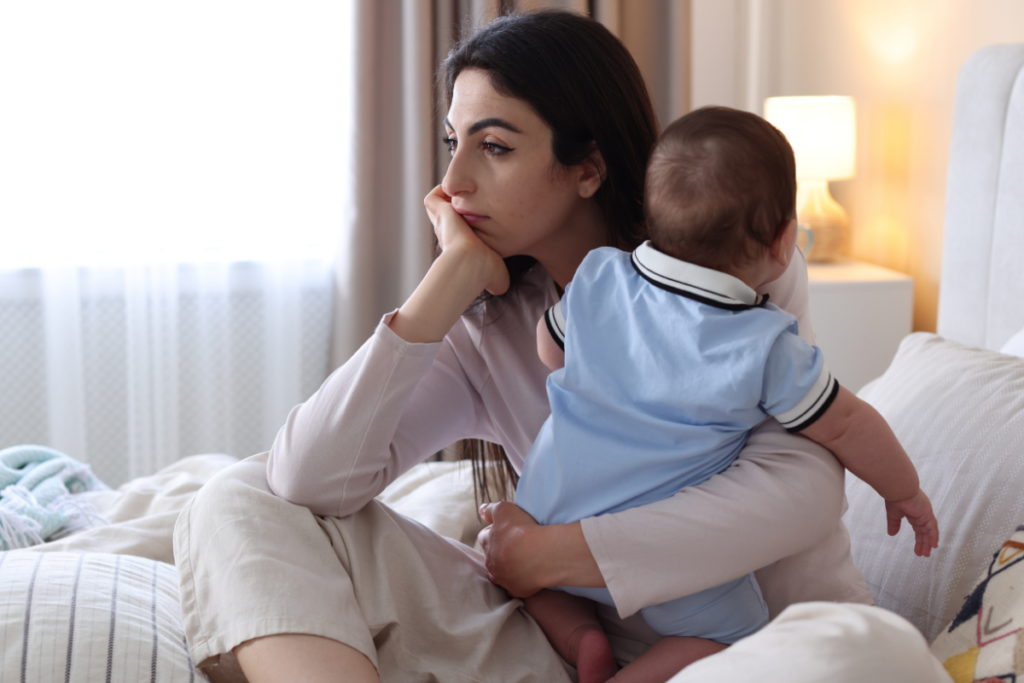
You made it through another day. The baby is still here, you’re still here — and somehow that should feel like enough. But as the afternoon light starts to fade and the clock creeps toward 4 or 5 PM, something shifts. A creeping dread settles in. Your chest tightens. The thought of the night ahead feels almost unbearable. You might find yourself watching the clock in a way that has nothing to do with feeding schedules — counting down not with anticipation, but with a low, steady anxiety you can’t quite name.
If this sounds familiar, you’re not alone — and you’re not broken. What you’re experiencing even has a name: the postpartum sundown scaries.
What Are the Sundown Scaries?
The “sundown scaries” (sometimes called the sunset scaries or the Sunday scaries) are a wave of anxiety, dread, or deep sadness that tends to arrive in the late afternoon or early evening during the postpartum period. It’s a phenomenon that’s been quietly talked about among new parents for years, and it’s finally getting the wider attention it deserves.
This isn’t just “being tired.” It’s a specific emotional experience — a shift that many parents describe as feeling like a cloud rolling in right around the time the day should be winding down. It can look like tearfulness, irritability, a sudden sense of doom, or a hollow ache that you can’t quite explain to your partner or anyone else who hasn’t lived it. And there are real, concrete reasons it happens.
It’s worth naming this clearly: experiencing the sundown scaries does not mean you’re a bad parent, that something is fundamentally wrong with you, or that you don’t love your baby. It means your body and brain are under significant stress, and they’re letting you know.
Tips for Postpartum Anxiety at Sundown (And Why Does it Hit Then?)
Several forces tend to converge right around that late-afternoon window, and understanding them can actually be part of what makes them more bearable.
Exhaustion and Depletion
By 4 or 5 PM, you’ve already been running on empty for hours — or days, or weeks. Sleep deprivation is one of the most acutely destabilizing things the human body can experience, and new parenthood delivers it in sustained, relentless doses. When our bodies are this depleted, emotional resilience is one of the first things to go. The coping resources you’d normally draw on — perspective, patience, self-compassion — are simply harder to access. What’s left is a rawness that makes even small things feel enormous.
Anticipation Anxiety
There’s something uniquely difficult about dreading something you know is coming but can’t predict. The middle-of-the-night wakings, the crying you won’t be able to immediately soothe, the bleary-eyed hours stretching out ahead — your nervous system can start bracing for impact long before it arrives. This is anticipatory anxiety, and it’s exhausting in its own right. You’re not just living through the hard moments; you’re pre-living them. Your brain is trying to prepare you, but in doing so, it’s burning through energy you don’t have and keeping your body in a low-grade state of threat response.
Hormonal Shifts
The postpartum hormonal landscape is dramatic. Progesterone and estrogen, which were elevated during pregnancy, drop sharply after birth. Cortisol — your primary stress hormone — can rise in the evenings. For some people, prolactin levels (associated with breastfeeding) add another layer of biochemical complexity. This hormonal cocktail can significantly impact mood, emotional regulation, and anxiety levels, even when nothing externally has gone wrong. Your feelings are not irrational. They’re often a direct reflection of what’s happening in your body.
Loneliness
Even when a partner is home, evenings can carry a particular kind of isolation. During the day there may be a sense of movement — errands, appointments, a text from a friend, even just the ambient noise of the world going about its business. As evening falls, the outside world quiets down. Neighbors go inside. Phones stop buzzing. And if you’re home with a newborn who can’t yet hold a conversation or make eye contact in a sustained way, the silence can feel enormous. Loneliness in new parenthood is rarely about being physically alone — it’s about feeling unseen and disconnected from the version of yourself that existed before.
Replaying the Day
Evenings are often when the inner critic gets loudest. Did I respond to her cry fast enough? Was I too checked out this afternoon? Did I spend too much time on my phone? Was I present enough? The mental load of new parenthood is relentless, and guilt has a way of surfacing precisely when the day is winding down and there’s no next task to redirect your attention. If you already have a tendency toward perfectionism or self-criticism, the postpartum period can amplify this in ways that feel overwhelming.
Strategies to Move Through It
The sundown scaries are real — but they’re also workable. You don’t have to simply endure the evenings. There are concrete, practical things you can do to soften their grip and help your body and mind feel a little safer as the light fades.
Create a Gentle Transition Ritual
Rather than dreading the evening as something that simply happens to you, try building a small, intentional ritual that signals safety to your nervous system. This doesn’t need to be elaborate. A warm shower before the witching hour begins, a short walk outside while there’s still light in the sky, putting on music that feels soothing rather than stimulating — something that says this is a transition, not a threat. The goal is to interrupt the automatic slide into dread by inserting something predictable and gentle. Over time, these small rituals actually begin to cue your nervous system to settle.
Light Up Your Space
It sounds almost too simple, but the physical environment matters more than we often give it credit for. As natural light fades, turn on warm lamps around your home before the darkness sets in. A dim, shadowy environment can unconsciously reinforce feelings of heaviness and unease. Keeping your space feeling bright, warm, and inhabited sends a subtle but real message to your brain that you are safe, that the world is still here.
Prioritize Small Comforts
Keep things nearby that soothe you — a favorite snack, a cold glass of water, a soft blanket, a candle with a scent you love. These aren’t indulgences; they’re nervous system resources. Your body is working hard, and small physical comforts communicate safety in a direct way. This is especially true if you’re breastfeeding, when your body’s caloric and hydration needs are high and the physical depletion of the late afternoon is real.
Divide and Conquer with Your Partner
If you have a partner, the evening is the time to be specific and strategic about support — not general and hopeful. Vague agreements like “we’ll figure it out” tend to fall apart under sleep deprivation. Agreeing in advance who handles the first night shift — so the other parent can have a guaranteed block of uninterrupted sleep — can meaningfully reduce the anticipation anxiety of the evening hours. Knowing that you will get a real stretch of rest, even if it’s just a few hours, changes the psychological weight of the night ahead. Sharing the load doesn’t have to mean splitting everything equally every night; it means being intentional and communicative about rest.
If you don’t have a partner, or if your partner is unavailable, think about who else might be able to step in — a family member, a postpartum doula, a trusted friend. Asking for help is not a failure. It’s how human parents have always survived the early months.
Regulate Your Nervous System
This is something I work on consistently with clients, and it’s especially relevant when it comes to the sundown scaries. Deep breathing, grounding exercises, gentle movement, skin-to-skin contact with your baby, a restorative yoga pose — these aren’t just “relaxation tips” to check off a list. They are tools that directly communicate safety to your brain and body by activating the parasympathetic nervous system. When your nervous system is regulated, anxiety loses its foothold. You may not be able to think your way out of the dread, but you can often breathe your way to a slightly softer place.
Even something as simple as placing both feet flat on the floor, taking three slow breaths, and naming five things you can see in the room can interrupt the anxiety spiral and bring you back into the present moment.
Lower Expectations and Practice Radical Acceptance
One of the most powerful — and most difficult — things you can do in these moments is practice what therapists sometimes call radical acceptance. This means fully acknowledging what is true right now, without fighting it. This is hard. I am exhausted. The night ahead is uncertain. And I will get through it. Radical acceptance isn’t giving up or pretending everything is fine. It’s releasing the enormous amount of energy you’re spending fighting against reality.
This phase will not last forever. The nights will get longer. The mornings will come earlier. Your body will begin to recover. Holding that truth gently without demanding it happen faster than it can is one of the quieter forms of self-compassion.
You Are Not Just “Anxious” — You Are Adapting
It’s worth stepping back for a moment to name something important: the postpartum period is one of the most significant neurological, hormonal, physical, and identity-level transitions a human being can go through. The fact that it’s hard — that evenings feel scary, that anxiety spikes, that you sometimes stare at the sunset and feel a grief you can’t explain — is not a malfunction. It is, in many ways, an appropriate response to an enormous change.
When to Reach Out for Support (A Perinatal Mental Health Therapist Can Help)
For many new parents, the sundown scaries ease over time as sleep improves, routines settle, and the fog of the early postpartum weeks begins to lift. But if the dread feels debilitating, if it isn’t fading after the early weeks, or if it’s starting to interfere with your ability to function, connect with your baby, or take care of yourself — that’s important information worth paying attention to.
This can be a sign of postpartum anxiety or postpartum depression, both of which are common, well-understood, and very treatable. Experiencing them is not a reflection of your love for your child or your capacity as a parent. It is a medical and emotional reality that deserves support — not just reassurance from well-meaning people telling you it gets better.
As a perinatal mental health therapist, this is work I am deeply connected to — in part because I’ve lived some version of it myself. My own path into motherhood was complicated and hard in ways I didn’t expect, and it shaped the kind of support I wanted to offer other parents. I specialize in helping new and expecting parents navigate these kinds of experiences: the anxiety that doesn’t have an easy explanation, the loneliness that coexists with profound love, and the quiet grief of feeling like you’re not quite yourself anymore.
In my work with clients, I draw on a combination of ACT (Acceptance and Commitment Therapy), somatic and nervous system-based approaches, Brainspotting, and mindfulness — because the postpartum experience lives in the body as much as it does in the mind.
If you’re ready to talk, I’d love to connect. You can learn more about my approach and schedule a free consultation.
You can also find community and additional resources through Postpartum Support International.

Michelle Page, LCSW PMH-C RYT, is a Licensed Clinical Social Worker, Certified Perinatal Mental Health therapist (PMH-C), and Registered Yoga Teacher (RYT) based in Denver, CO. She specializes in postpartum depression, postpartum anxiety, perinatal OCD, and the emotional challenges of new parenthood. To learn more or schedule a consultation, click here.
Address: 217 E 7th Ave, Denver, CO 80203
Phone: (917) 409-7042
Book Online: https://michellepagettherapy.com/contact
Get Social with Rise & Flow Counseling: